
Quick Summary
- Contrary to popular market myths, Venezuela possesses vast deposits of high-quality light and medium crude alongside its famous extra-heavy reserves.
- Strategic blending of 39° API Santa Barbara light crude with Maracaibo barrels produces medium crude perfectly calibrated for U.S. Strategic Petroleum Reserve (SPR) refineries.
- Leaked sector data reveals that 8 of 17 key operational oilfields represent mature, high-value light and medium crude operations in Western Venezuela.
1. Dissecting the Great Crude Misconception
Energy analysts and narrative-driven commentators often repeat a singular, flawed thesis regarding Latin American energy reserves. They falsely claim that South America’s largest energy powerhouse is purely trapped in heavy sludge.
Statements asserting that “Venezuela only has heavy crude” are propagated by illiterate observers who mistake the Orinoco Belt for the entire country. This narrow perspective completely ignores decades of geological data and active production infrastructure in Western basins.
While Eastern Venezuela contains vast extra-heavy deposits, the nation’s total geological footprint is radically diverse. Geological surveys confirm substantial high-grade reserves spread across multiple Western basins.
- Geological Nuance: The Orinoco Oil Belt represents raw volume, but Western basins supply operational flexibility.
- Market Impact: Treating Venezuela as a single-grade producer distorts global refining valuation models.
- Refinery Dynamics: Global complex refiners require balanced slates, which Venezuela can natively support internally.
Understanding Venezuela’s operational reality requires evaluating specific API gravity metrics rather than sweeping generalizations. Dismissing the nation’s light oil streams overlooks billions of dollars in fast-to-market trade potential.
2. Santa Barbara & Maracaibo: The Light Oil Engine
The crown jewel of Western Venezuelan production is the legendary Santa Barbara field. Santa Barbara yields ultra-desirable 39° API light crude that commands significant premiums on global markets.
This light crude acts as a crucial strategic catalyst for domestic and international midstream operations. Its low viscosity and low sulfur profile make it an ideal natural diluent.
- High API Gravity: At 39° API, Santa Barbara crude flows easily without energy-intensive heating or chemical processing.
- Economic Advantage: Eliminates the costly need to import foreign naphtha or light condensate for blending.
- Refinery Efficiency: Yields higher percentages of high-value transportation fuels like gasoline and jet fuel.
Further west lies the historic Lake Maracaibo basin, home to multiple mature field networks. Maracaibo generates several distinct crude streams with gravities consistently exceeding 27° API.
These Western streams provide immediate operational flexibility that heavy-oil projects simply cannot match. They require significantly lower capital expenditure to extract and process.
3. The SPR Blending Math: Creating Perfect Refiner Feedstock
The U.S. Gulf Coast refining complex is specifically engineered for medium, sour-to-sweet crude slates. The U.S. Strategic Petroleum Reserve (SPR) requires precise gravity and sulfur parameters for commercial compatibility.
Here is where Venezuela’s dual-reserves create a massive strategic shortcut for global energy traders. When you blend 39° API Santa Barbara light crude with heavier Maracaibo barrels, you create an ideal medium crude.
- Targeted Gravity: Blending achieves an ideal 28° to 31° API density profile preferred by Gulf Coast operators.
- Sulfur Customization: Adjusting stream ratios allows producers to meet strict low-sulfur ceiling requirements.
- Logistical Efficiency: Direct coast shipping from Western terminals drastically reduces transit days to Texas and Louisiana.
This custom-blended stream matches U.S. Gulf Coast import specifications without needing costly offshore processing. The resulting medium crude fits perfectly into existing American refining configurations.
Maracaibo’s multiple 27°+ streams offer customizable sulfur ranges required by strict environmental regulations. Energy traders can dial in exact density metrics to optimize refinery crack spreads.
This chemical synergy proves that Venezuela possesses built-in operational hedge capabilities. The country can shift export profiles based on real-time refinery demand signals.
4. Field Level Breakdown: The 17 Key Oilfields
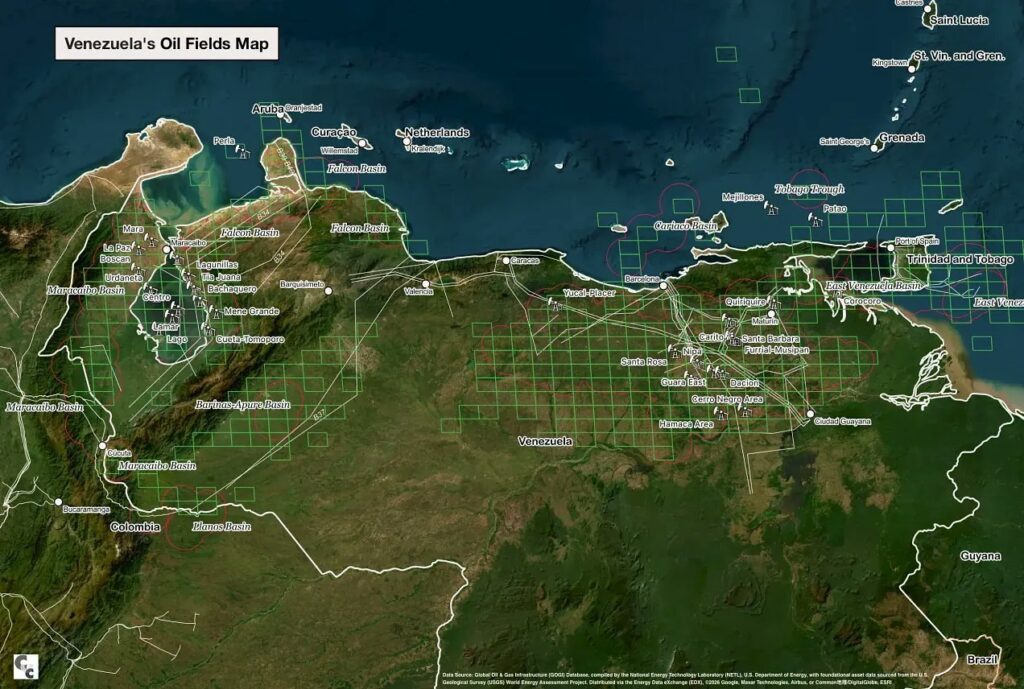
Recent intelligence from unofficial industry sources has published details regarding the 17 operational oilfields in question. This data offers clear evidence regarding the nation’s balanced resource division.
Nine of these key fields are indeed extra-heavy crude projects situated across the Orinoco Oil Belt. These massive fields represent long-term volume reserves requiring sustained long-term capital.
- Orinoco Heavy Fields (9 Fields): Focus on sheer volume, requiring upgrader facilities and heavy infrastructure.
- Western Mature Fields (8 Fields): Focus on immediate, low-cost extraction of light and medium crude streams.
- Geographic Balance: Production is geographically split between Eastern mega-structures and Western legacy fields.
The remaining eight fields are mature light and medium crude fields located in Western Venezuela. These mature fields require far less initial capital expenditure to restart and scale.
This 9-to-8 distribution highlights a perfectly balanced energy portfolio. Investors who focus solely on Eastern extra-heavy projects are missing half of the operational picture.
5. Geopolitical and Infrastructure Advantage
Western Venezuelan oil assets benefit from superior logistical positioning relative to Atlantic shipping lanes. Shallow-water and deep-water terminals along Lake Maracaibo and the Caribbean coast speed up tanker turnarounds.
Restarting mature Western wells requires fractional capital compared to constructing new Orinoco upgraders. Low-hanging infrastructure rehabilitation can unlock rapid production increases within months.
- Terminal Proximity: Direct access to Caribbean export docks eliminates expensive long-distance inland pipelines.
- Rapid Deployment: Workovers on mature Western wells yield immediate light-grade production spikes.
- Refinery Alignment: Proximity to U.S. Gulf Coast facilities cuts sea transit time to under four days.
Global energy markets desperately need flexible, fast-turnaround medium and light crude sources. Western Venezuela’s mature fields are perfectly positioned to meet this precise global demand gap.
Opportunity Window 🏆
Capitalizing on the Mispriced Venezuelan Energy Transition: Market consensus vastly underestimates the rapid execution speed of Western Venezuelan field workovers. Investors positioned in service providers and refiners with existing licenses stand to gain significant margin advantages.
- Refinery Margin Expansion: Gulf Coast refiners configured for medium crude can secure discounted feedstock through optimized Venezuelan blending schemes.
- Low-CapEx Energy Services: Oilfield service contractors focusing on mature Western well workovers enjoy faster payback cycles than deepwater projects.
- Midstream Infrastructure Play: Specialized logistics providers capturing Western light crude blending flows will control high-margin bottleneck assets.
Who did what today? 📈
- Chevron Corporation — (NYSE: $CVX @ $158.45)
- SLB (Schlumberger) — (NYSE: $SLB @ $48.20)
- Valero Energy Corporation — (NYSE: $VLO @ $132.10)
- Halliburton Company — (NYSE: $HAL @ $34.75)

